The vast majority of US colleges and universities automatically enroll international students in on-campus SHIP insurance, and the Insurance premium is directly added to the tuition bill. If you want to independently opt for off-campus insurance with a higher cost-performance ratio, you will need to complete the US study health insurance Waive (insurance waiver).
Many students get their applications rejected on their first try, and missing the deadline forces them to purchase expensive on-campus insurance. This article compiles the latest 2026 general review criteria, a complete list of required materials, and a full set of remediation plans for rejected applications, with accurate content that you can follow and check directly.
I. Core Prerequisites for Waiving Study in the US
Essentially, Waive is a process to prove to the school that the off-campus insurance you purchased on your own provides coverage equal to or greater than the mandatory on-campus insurance; once the school approves your application, the on-campus insurance fee deduction will be waived.
⚠️ Several non-negotiable hard rules to keep in mind:
- Reapplication is required for each academic year / semester, and the exemption qualification will not be automatically extended;
- Standards vary from school to school, and all requirements are subject to the official website of the student health center of your university;
- Travel insurance and single-trip short-term overseas insurance can almost never pass the waiver review for studying in the US.
- There is a strict deadline; once the deadline expires, the channel will be closed, and no exceptions for extensions will be granted.
II. Official Review Rules for 2026 (General Standard for 90% of Colleges and Universities)
Check item by item before purchasing insurance to avoid most rejection risks:
1.Underwriting Qualification
Most comprehensive universities require insurance companies to hold a local underwriting license in the US, a US claims office and a customer service hotline; plans from purely overseas insurance companies are highly likely to fail the review.
2.Coverage Period
The insurance effective date shall be no later than the semester opening date, so that the coverage fully covers the entire semester/academic year without any coverage gap, and continuous underwriting shall also be provided during winter and summer vacations.
3.Basic Coverage Amount and Deductible Standard
- The annual deductible is usually required to be no more than $500
- The annual individual out-of-pocket maximum shall not exceed $10,600 (the general ACA standard)
- Emergency medical evacuation: ≥$50,000; Repatriation of remains: ≥$25,000 (mandatory requirement for J1 visa)
4.Mandatory Requirements for Coverage (Missing Any of These Will Likely Lead to Rejection)
✅ Outpatient, inpatient, emergency and prescription drug coverage
✅ Outpatient and inpatient treatment for mental illness (same treatment as for common diseases)
✅ Preventive check-ups, vaccinations, and maternity-related benefits
✅ There is a cooperative medical network around the campus, and the insurance coverage shall not be limited to emergency treatment only
❌ Reimbursement-only post-facto models are not accepted, and low-coverage insurance products designed for major disaster scenarios are not accepted
Pro Tip: Applications to the University of California system and private institutions in the Northeast undergo stricter review. It is recommended that you search for past successful US study waiver cases at your own university before selecting a plan.
III. List of Required Materials for Waiving When Studying in the US (All Must Be in English Version)
Pack all documents in advance instead of rushing to prepare them right before the deadline:
- Insurance Card (Insurance ID Card)
- Official Summary of Benefits Coverage (SBC) / Summary of Benefits (Most Important! This document is the primary reference for reviewers)
- Certificate of Coverage, which clearly shows: name (exactly consistent with that on the I-20), policy number, and coverage start and end dates
- Instructions on US Insurance Company Customer Service Hotline, Claim Submission Address, and Network Medical Institutions
- Additional requirements from some schools: original insurance policy clauses, direct billing network documentation
📌 Tips to avoid pitfalls when filling out the form: Make sure the name spelling strictly matches that on your passport and I-20; do not manually estimate the policy start and end dates, and directly copy the official dates on the insurance policy, as even minor errors will lead to direct rejection of your application.
IV. Correct Application Process
1. Log in to the official website of the university, locate the student health center, find the entry for the Waiver application, and note down the opening hours and deadline;
2. Purchase a student insurance policy that meets all the specified requirements (such as uniteCare) and obtain the complete set of official English documents;
3. Fill in the exemption application form online during the open window period and upload all required materials completely;
4. Wait for review after submission; the regular review cycle is 5–10 working days;
5. Receiving an offer via email counts as completion; if a rejection letter is received, immediately initiate remedial measures.
V. Waive for Study in the US Rejected? How to Appeal and Remedy
Read the rejection letter sent by the school carefully and take targeted measures based on the stated reasons for rejection. Do not directly resubmit the exact same materials.
📌 Common Rejection Reasons & Solutions
- The safeguard clause fails to meet the school's standard solution: replace the exemption-friendly compliant insurance, and resubmit after obtaining the complete set of documents again.
- Missing materials, non-English documents, and inconsistent information spelling: Solutions: unify the file format to PDF, correct names and dates, and complete the SBC coverage summary.
- Do not accept solutions from non-US domestic underwriters: directly select exclusive insurance for international students that holds a US license and supports the waiver requirements of various universities.
- Solution for the issue that the coverage start and end dates cannot fully cover the semester: Adjust the effective time of the insurance policy to ensure seamless connection.
📌 Standard Operating Procedures for Appeals
- Confirm the appeal deadline (most schools set it 10–14 days after the rejection letter is issued), as you will lose the appeal eligibility if you miss the deadline;
- Prepare supplementary supporting documents in accordance with the issues specified in the rejection letter;
- Write a concise and formal English appeal email, with the template as follows for reference:
Subject: Appeal for Denied Health Insurance Waiver + Full Name + Student ID Body Brief: Student ID, applied semester, explain point-by-point how the insurance policy meets the university's requirements in accordance with the school's regulations, and attach all insurance policy documents as attachments.
4. Send it to the school insurance office and keep the proof of email delivery;
5. Please keep an eye on your email during the appeal period and respond promptly to the school's requests for additional materials.
Waive policies for studying abroad in US universities vary from one institution to another, and oversights in application materials can easily lead to the failure of a waiver request.
If you need exclusive guidance on institution-specific materials and compliant insurance solutions, you can add the uniteCare consultant on WeChat for consultation. uniteCare updates the waiver policies of universities across the United States in real time to help you successfully complete the insurance waiver process.
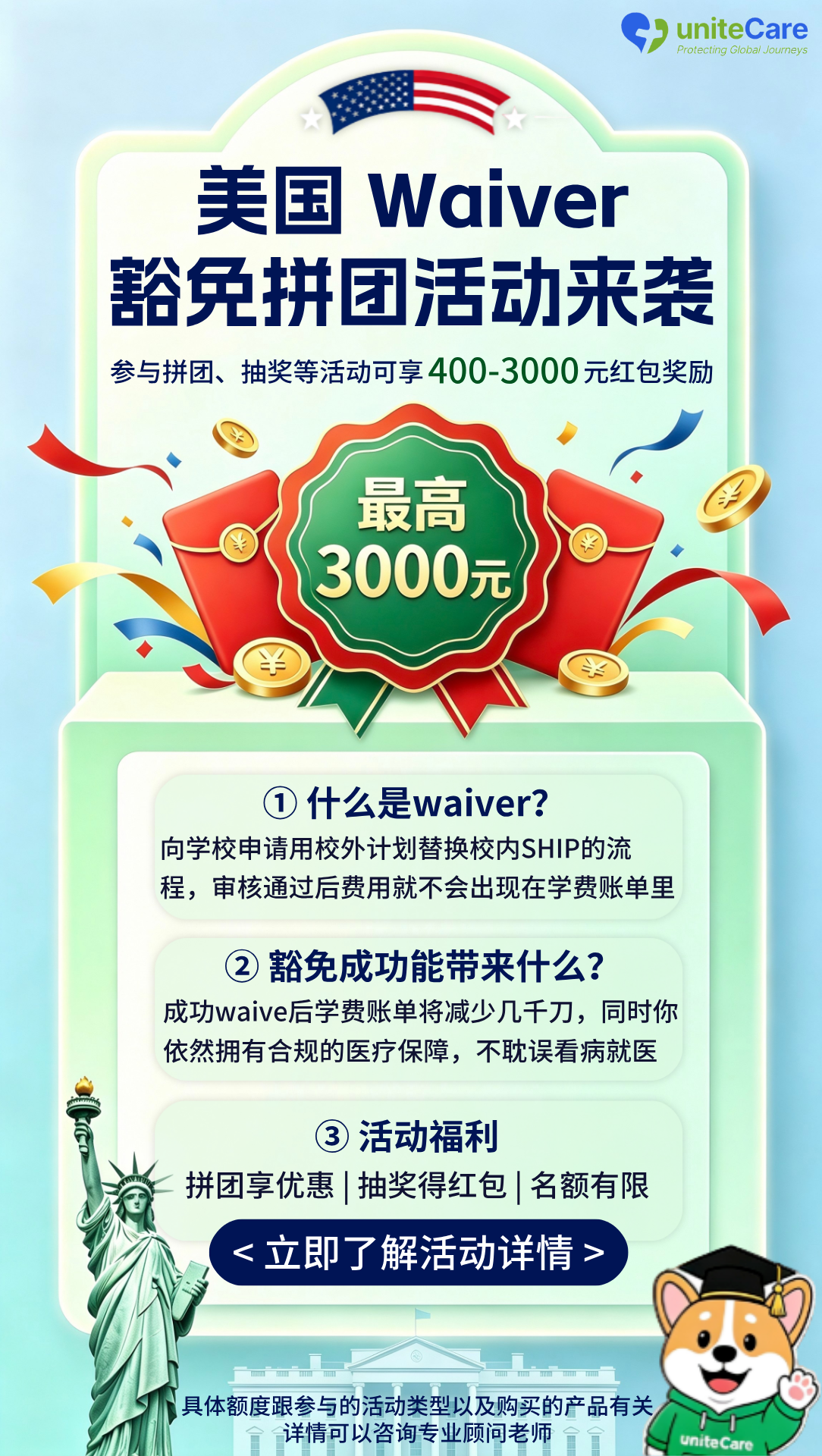
US Insurance Waiver Campaign Launched
Join group buying and lucky draws to claim up to 3000 yuan in red envelope rewards!
*【The specific quota is subject to the type of activity participated and the products purchased. For details, please consult a professional consultant. 】